

Haven't experienced itAnterior Cruciate Ligament (ACL) TearIt’s really hard for anyone who hasn’t been through it to understand that kind of fear. But once you’ve been through it, you’ll never forget that moment when you got hurt—that dull yet crisp “snap” that rang in your ears.
Everyday Life After the Breakup: Nightmares and Rebirth
That heart-wrenching sound of tissue tearing often occurs during a sudden stop and change of direction on the court, an unstable landing after a jump, or an unexpected twist while skiing. In that instant, the knee loses its pivotal point for maintaining anterior-posterior stability, leading to an acute joint hematoma that causes the once-flexible knee to instantly swell, ache, and lock up. That “pop” feels as if someone has ruthlessly pressed the pause button on your body, instantly stripping you of the mobility you once took for granted.
From that day on, my legs—which had once been able to run and jump freely—could no longer even maintain a normal weight-bearing gait. The once-keen proprioception within my joints has become dull and vague, replaced by a deep fear and sense of helplessness with every step I take—a fear that my knees will give way again.
After your injury, do these anxieties keep running through your mind?
- "After the surgery, will I really be able to run around the field just like I used to?"
- "When will I finally be able to let go of this heavy crutch once and for all?"
- "I really want to get back on the court as soon as possible, but right now, even walking down a flight of stairs feels like my knee is about to fall apart..."
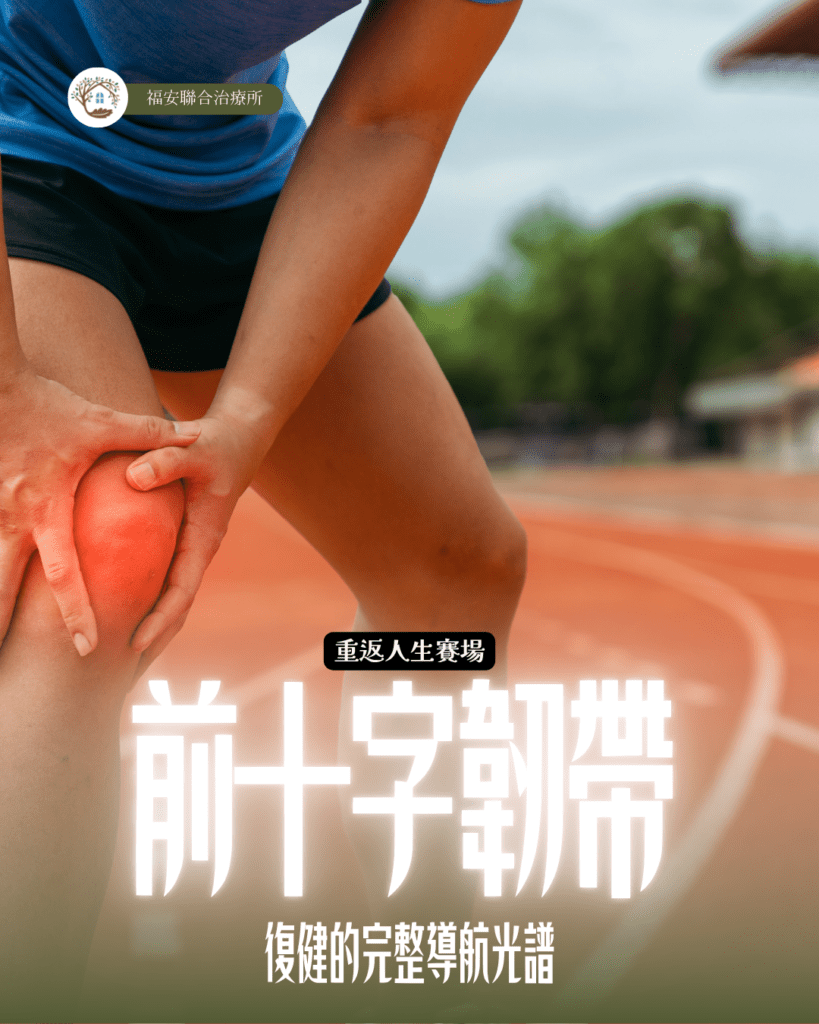
復健的完整導航光譜.webp "Returning to the Game of Life: A Comprehensive Guide to Anterior Cruciate Ligament (ACL) Rehabilitation")
Anxiety and Unease About the Outcomes of Recovery
Since most of the cases I deal with on a daily basis involve injuries sustained on the sports field, every time I see a patient’s anxious and helpless expression as they face the long road to recovery after an injury, I may not be able to fully empathize with them; but I believe I can understand the agonizing pain of facing a future filled with uncertainty, as well as the heartbreak and regret of perhaps never again being able to sweat it out on the field with the same freedom and joy as before. The anxiety following a cruciate ligament injury often stems from a strong sense of uncertainty about the “future.” This is not merely a grueling battle for the body’s tissues to heal; it is also a psychological marathon that severely tests one’s willpower.
Rehabilitation Navigation Spectrum: Achieving Twice the Results with Half the Effort to Help Clients Regain Mobility
在Fuan United Treatment Center, We are committed to helping you establish a clear “Rehabilitation Navigation Spectrum", so that this long and challenging road to recovery is no longer a journey in the dark, but rather a journey of healing with a clear goal and full of hope.
A Four-Stage Structured Rehabilitation Process: It’s Not About Speed, but About Taking Each Step Solidly
Postoperative rehabilitation for ACL injuries is by no means a matter of blindly following a set schedule; rather, it requires dynamic adjustments based on each individual’s tissue healing progress and the type of surgery (such as autograft or allograft ligament reconstruction). We have precisely divided the rehabilitation process into the following four key stages:
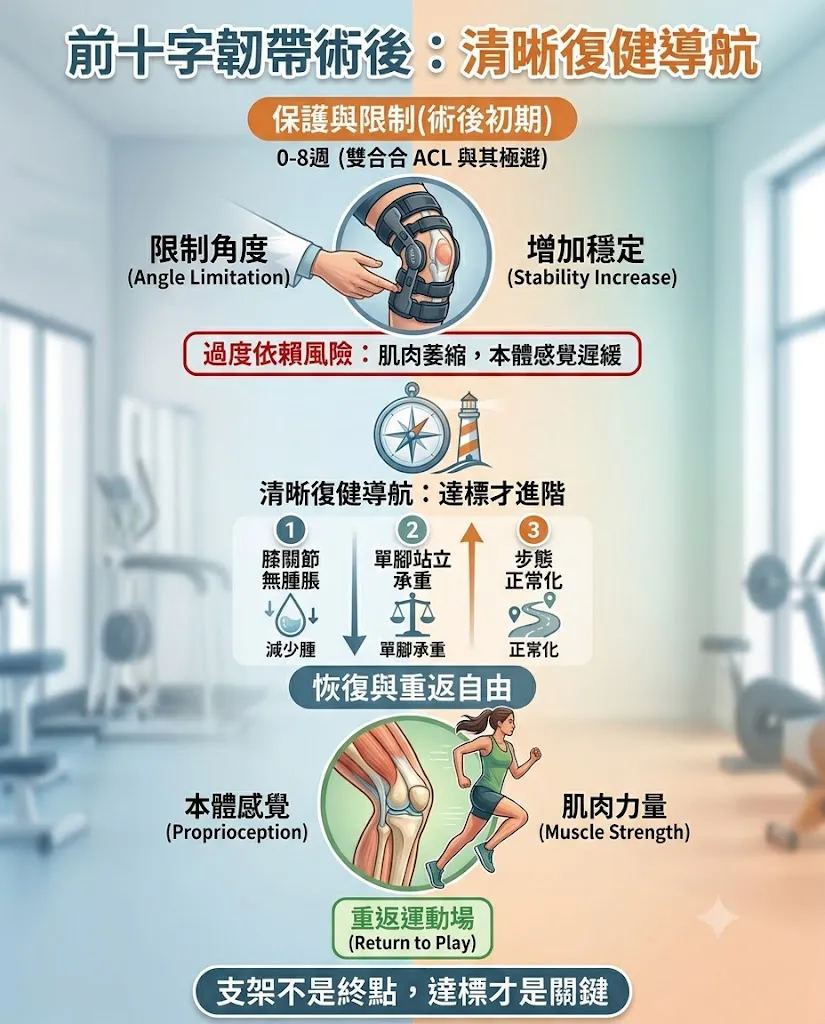
Early Postoperative Period (Weeks 0–4): Breaking the Ice and Achieving the Optimal Angle
復健的完整導航光譜00.webp "Returning to the Game of Life: A Comprehensive Guide to Anterior Cruciate Ligament (ACL) Rehabilitation")
- Key Objectives: Control postoperative swelling, inflammation, and pain; reactivate dormant quadriceps muscles (to prevent rapid muscle atrophy); and actively work toward achieving “full extension” of the knee and a basic range of flexion.
- Unlock Missions: I am able to walk correctly and without pain while bearing weight with the aid of a cane; I no longer wake up frequently at night due to sharp pains in my knees.
Mid-Rehabilitation Phase (1–3 months): Muscle Strength Building and Gait Rehabilitation
復健的完整導航光譜01.webp "Returning to the Game of Life: A Comprehensive Guide to Anterior Cruciate Ligament (ACL) Rehabilitation")
- Key Objectives: Gradually wean off crutches and restore a normal gait. Comprehensively strengthen the lower-body kinetic chain (including the quadriceps, hamstrings, glutes, and calf muscles), and incorporate key “proprioception” training to reestablish the connection between nerves and muscles.
- Unlock Missions: I no longer feel fear or weakness when going up and down stairs; I can stand on one leg with complete stability; and the range of motion in my knee has almost returned to that of my healthy side.
Late Rehabilitation Phase (3–6 months): Agility Training and Straight-Line Running
復健的完整導航光譜02.webp "Returning to the Game of Life: A Comprehensive Guide to Anterior Cruciate Ligament (ACL) Rehabilitation")
- Key Objectives: Enhance explosive power and muscular endurance in the lower limbs, and reestablish the biomechanical foundation for running. In this phase, we will begin incorporating basic plyometric exercises, such as two-footed squat jumps.
- Unlock Missions: Be able to jog on a treadmill smoothly and without pain; as verified by scientific testing,Lower Limb Muscle Strength Symmetry Index (LSI) Reaching the healthy side of 70-80% That's all.
Returning to Competition (6–12 months or more): Advanced Movement and Braking Training
復健的完整導航光譜03.webp "Returning to the Game of Life: A Comprehensive Guide to Anterior Cruciate Ligament (ACL) Rehabilitation")
- Key Objectives: Incorporate simulated movements specific to each sport (such as a sudden stop and change of direction in basketball, kicking in soccer, and a cross-step in badminton), high-intensity single-leg jumps and landing stability drills, and simulate the unpredictable physical contact that occurs during competition.
- Unlock Missions: All functional jump tests and muscle symmetry indices (LSI) were within the range of the healthy side’s 90% In addition, the patient expressed full confidence in the injured area during the psychological assessment and is ready to take on the high-intensity challenges of competition.
Comprehensive Professional Support: Fu'an United Therapy Center Is Your Strongest Support System
At Fuan Joint Therapy Center, we don’t just treat “injured knees”—we care about “you, the person who’s injured.” To ensure you can safely and confidently return to your daily life and the field, we offer the following core professional services:
- 🎯 One-on-One Goal Discussions and Customized Plans: Every sport places completely different demands on the body. The rehabilitation goals for playing high-intensity basketball and weekend hiking are absolutely different. We’ll have an in-depth discussion with you to establish personalized “Return to Sport” criteria, so you can focus your efforts where they matter most and avoid taking unnecessary detours.
- 🎯 Testing using clear scientific criteria: Progressing to the next stage of rehabilitation is definitely not just a matter of “feeling.” We use professionalPhysical Therapy Assessment InstrumentsWe measure your range of motion, isokinetic strength, and dynamic stability. You can only advance to the next level once your data meets the standards, ensuring your safety is strictly safeguarded.
- 🎯 Seamless Transition to Home-Based Learning (HEP): Successful rehabilitation can’t rely solely on that “golden hour” at the clinic. Each week, we’ll update your personalized “Home Exercise Program,” incorporating real-life scenarios so that rehabilitation becomes a natural part of your daily routine.
- 🎯 Mental Preparation and Support Systems: Clinically, many people continue to suffer from severe “kinesiophobia” even after their physical metrics have returned to normal—they are afraid of hearing that “pop” again and dare not give it their all. During this uncertain transition period, Fu’an’s physical therapists and professional team will work together to serve as your strongest emotional support, accompanying you step by step as you overcome the high walls of fear within your heart.
"At Fu'an, treatment isn't just about relieving symptoms—it's about helping you return to a better life."
Do you have a friend who’s just had ACL surgery and is feeling lost and discouraged about the long road to recovery? Feel free to share this article with them to let them know: they’re definitely not alone on this journey back to the field of life.
Further Reading